Showing posts with label Dungeness. Show all posts

Sunday, October 10, 2010

Outside The House That Thomas and Lucy Built


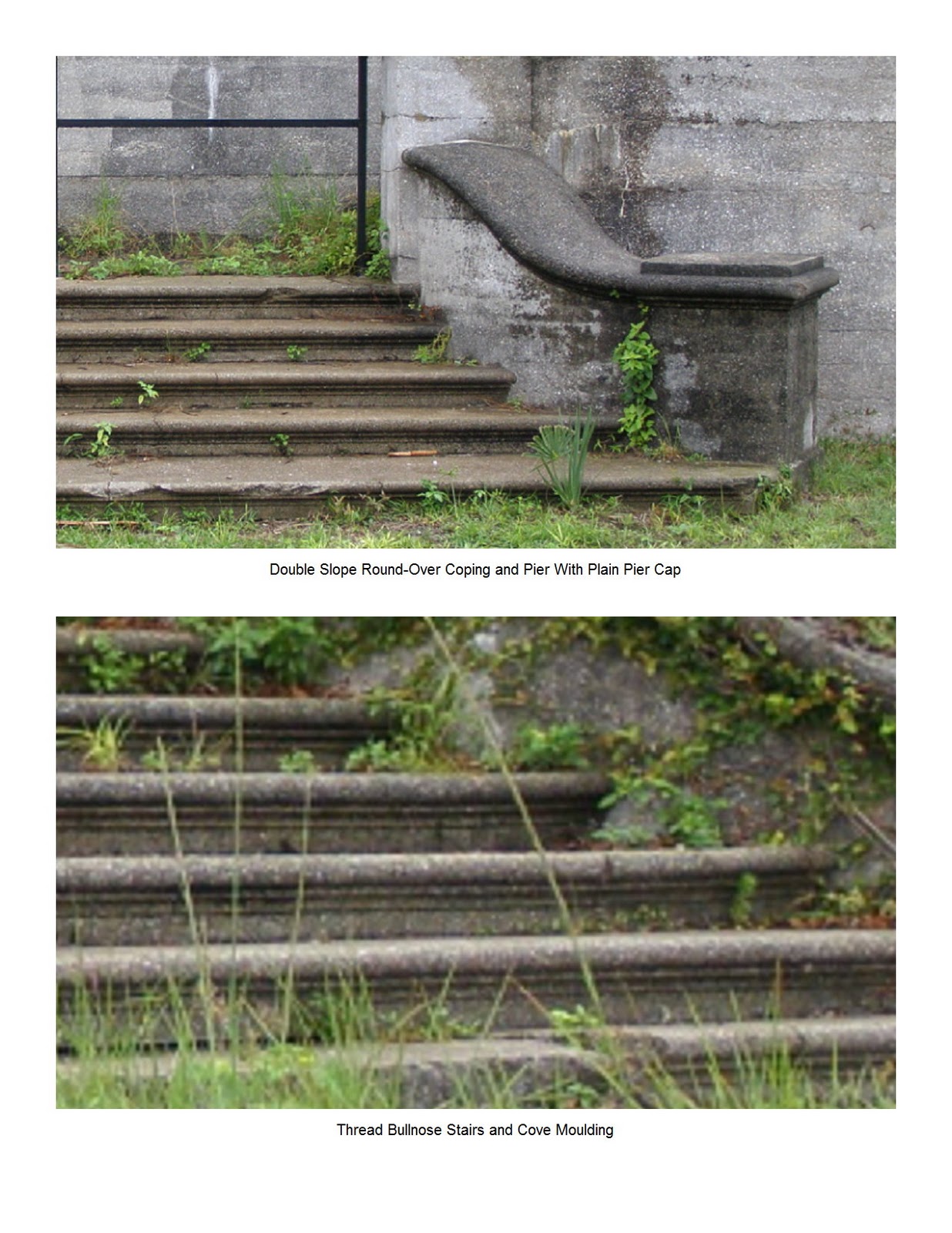
Below are intriguing glimpses of photo details that I have taken of Dungeness. The ruined mansion sits silently awaiting for visitors to the picturesque island of Cumberland.  The concrete and granite veneer brick walls spike upwards towards the sky revealing a few reminders of it's architectural existence.
Few visitors will realize the incredible identity that the mansion has with her superb original details that are left intact. Their glances may be one of: remnants of a once grandeur of lost time.
Me, I'm a visual person. My glance is one of: I see the evidence of the grandeur that once was and I search for the details trying to visualize what it once had looked liked.

Below, a mansion hopeful to be not
forgotten amid her heavily wooded preserve.

This is what I see!


Segmental, Anse De Panier, and Stilted Arches

 Voussoirs, Soffits, Extrados,
 Springers, and Impost


Stone Moulding - Throated
Water Drips Underneath


Thursday, August 26, 2010

DELTIOLOGY

Deltiology is the study and collection of postcards. If I'm discussing deltiology, your correct in thinking that I have a collection of postcards on Cumberland Island. The collection is a small one, exactly seven. Another collection of mine that I started twenty five years ago is on Savannah Georgia.

I've plundered through many a shoebox stuffed with postcards in antique stores and flea markets. When you are on the hunt for antique postcards, nothing can beat the thrill when you cross upon one that you are passionate about.
Many categorized subjects are covered by the old postcards.  The specific subject that I collect is called View Postcards, which are street scenes, buildings and landscapes.

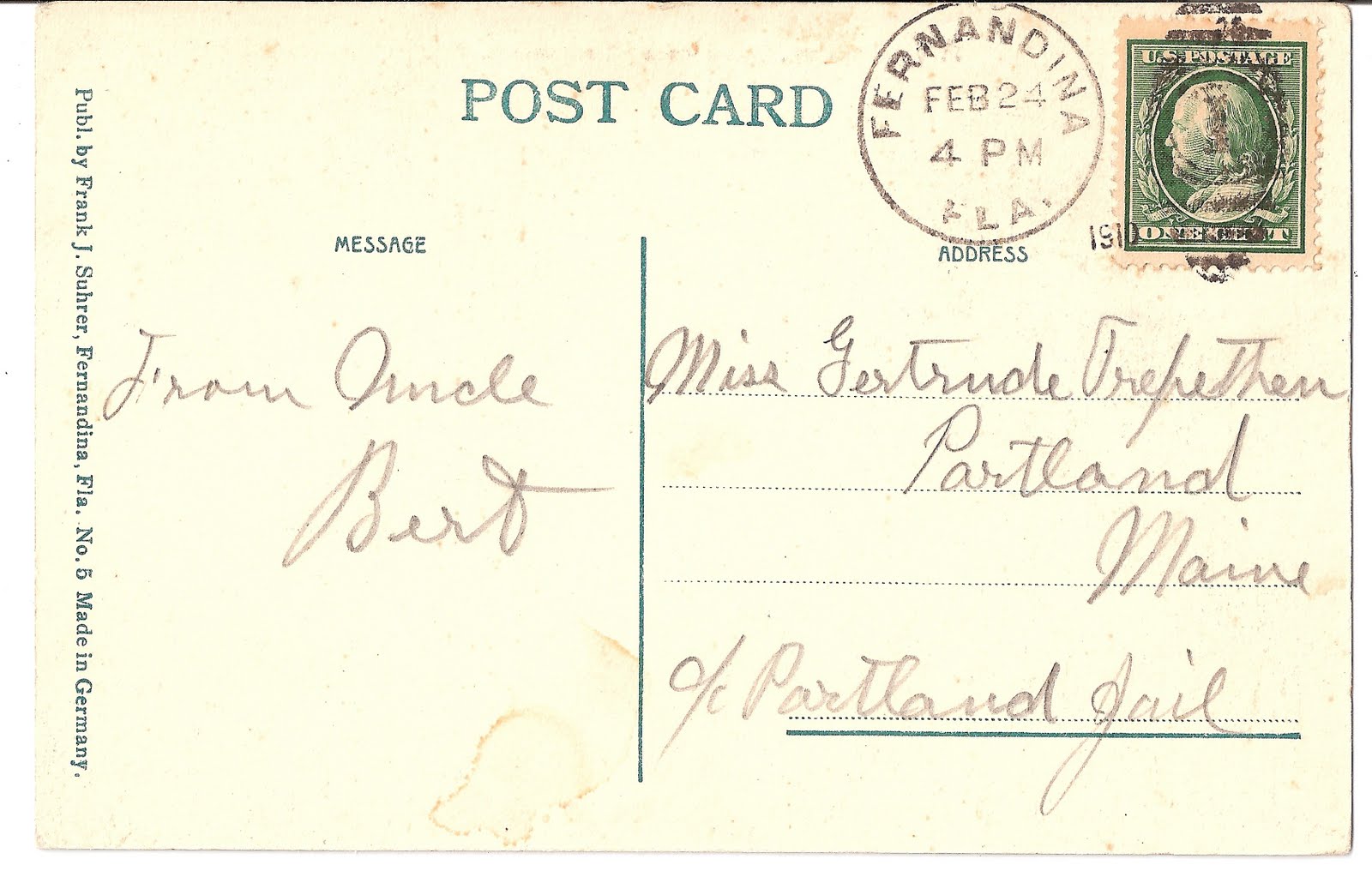
Unlike other countries, postcards printed in the U.S. in the early 1900's were printed with an undivided back. Writing was limited to the front with the design and the back for addresses. It was not until 1907 that the U.S. Government granted publishers the right to divide the back. Until then, many of the U.S. postcards were printed in Europe. After 1915, most of the postcards were printed with a white border.

Dungeness
Undivided Back
Era
1901-1907
The postcard above was actually mailed
to a residence in my hometown.

If you are a deltiologist, the first thing you will notice when you start to form a collection is that the older postcards were used to send brief messages like the one above and below.   Its probably hard for people of my generation to imagine that the postal service actually delivered twice a day back then.  Without power lines and phones, this was the way to get a short message to family and friends.  In the morning, send Aunt Martha a card,  "Coming for supper tonight!"  That afternoon she'll send you a postcard back, "Not tonight!"

Dungeness
Divided Back
Era
1907-1915


 Dungeness lower gardens


The Pool House


Stafford


Plum Orchard


Half Moon Bluff
If you know the history of the island,
you'll figure out who the above sender was.

Wednesday, August 4, 2010

Torpedo Bottles

Previously, I mentioned in an post that my parents and relatives visited Cumberland Island in the summer of 1970. See the link below:

http://bubbajunk-asmalltownboy.blogspot.com/2010/06/plum-orchard-carriage-house.html

Back then, The National Park Foundation had been recently established by Congress for the purpose of purchasing "collecting" property on Cumberland Island for a possible future of a national seashore under the jurisdiction of the NPS. The well established non-for-profit Andrew W. Mellon Foundation contributed to the NPF roughly $5.5 million to  purchase Fraser's two tracts towards the possible seashore. My Uncle Joe had caught wind of that fact and retained permission from Charles Fraser for my family to visit and camp on his southern tract.


Being the avid antique bottle hunters that they are, my family while camping descended upon the old Dungeness household dump site.  Below are a few photos of some of the antique bottles dug from the old household pit.
 
Torpedo Bottles

The bottles above are known as torpedo bottles. The molded bottles were designed with rounded bases to ensure that they rested on their side so the wired down cork in the blob would not dry out. The torpedo bottles were used for ginger ale, soda, and mineral waters.
The majority of the bottles that are dug or found in this country date from the 1870's to the 1910's and were imported from the United Kingdom. The most common type were ginger ale bottles.
The company that dominated the market in the late 1800s was the firm Cochrane and Cantrell.


The bottles above are worth very little. 
If your fortunate, $10.00 a pop.

 
Tinted aqua or green torpedo bottles with no embossing are very common. Torpedo bottles that are colored amber, emerald green, or cobalt blue are worth more.


Ceramic Jam Crocks

The crocks have the same inscription stamped on the bottom. Only one has a label applied before glazing that is decorated with acorns and leaves bearing the inscriptions: GRAND MEDAL OF MERIT VIENNA 1873 - JAMES KEILLER & SONS - DUNDEE MARMALADE - ONLY PRIZE MEDAL FOR MARMALADE LONDON, 1862 - Great Britain.

It is great that the torpedo bottles and crocks have survived for over a hundred years.  We will donate the many torpedo bottles and ceramic crocks to the CUIS.


Friday, July 30, 2010

Dawson's Excellent Adventure


Last weekend, my sister and I went to Cumberland Island.  I told her to brace herself for a magnificent scenery of palmetto thickets, a windswept beach, gnarling massive oaks draped with spanish moss, wildlife, and crumblings ruins. What a peaceful setting and natural wonder that we will remember, forever.


It was no cool day as we docked on the island.  In fact, it was 100 degrees on Friday, so we were quite warmed up even before our scenic hike.


No tour guide for us, we took the off beaten path direct to The Cottage and their it lay.  I thought a daily jog got my heart pumping.  Well, seeing this view below for the first time was worth every penny of any oxygen debt that I had.  This concrete ruin was the duck pond at the site of The Cottage.


My sister looked at me kinda crazy when I got to giggling over this small concrete ruin. The first stop and she was stuck. Thank God that horses arrived to occupy her for a while. If that "turtle lady" on the island had had her way, their would have been no horses and she'd would have probably been going crazy! 


Below is a link to an old photo of the duck pond at The Cottage Site.


Below is a link for The Cottage which burned down in the 1950's.


The views of the two photos are from the Georgia Archives Collection - Vanishing Georgia Series. They are actually copies taken from a Carnegie photo album now located online at the Georgia's Virtual Vault - Carnegie Family Collection website.


The Tour Begins!

I'm not gonna bore people with the typical photos of the Dungeness ruins and pergola. You'll find plenty on the web.

The Cottage Site 

   Dungeness Estate Support Structures


Another Oxygen Debt Moment
While we were checking out the west side of the kitchen building, I noticed a construction dumpster next to the woods. I knew in an instant why it was placed there. My sister and I were about to be going into the woods to a site that almost every tourist knows not a thing about, notta, no clue what so ever. At the edge, as we peered into the sunlight filtered and diffused forest, I was excited to see that the NPS had started clearing out a former site that I wanted to show her. See Below!!!

Rikart House and Play House Sites

 Check Page 3, lower right, for a photo of an early view of the Rikart House:


Check Pages 16,17, & 18 for photos of the Play House:


Miles of undisturbed sand dunes,
a quiet white beach,
 and a lot of dead horseshoe crabs?

 
Wildlife
I guess on this sweltering day, all other wildlife were smart
and napped in the shade.  All we saw were wild horses that ignored us and not to smart turkeys.